
Search for the “best retirement annuity in South Africa” and you will quickly find rankings of providers, platforms and funds. The problem is that a retirement annuity is not one investment. It is a retirement-fund structure that can hold very different underlying portfolios — and those portfolios can produce very different outcomes.
The latest balanced-fund data makes that point particularly well. Using the South African Multi Asset High Equity peer group to 31 July 2026, the leading funds over three years are not the same as the leaders over ten years. Low-cost core strategies have also competed surprisingly well with many traditional active funds.
That makes performance useful evidence, but a poor decision rule on its own. A sensible RA decision also considers costs, diversification, the manager and investment process, downside risk, Regulation 28, your time horizon and — most importantly — the role the RA needs to play in your wider retirement plan.
This guide explains both sides of that equation: why retirement annuities remain useful planning structures, and what the latest performance evidence can and cannot tell you about choosing the investments inside one.

- Key Definitions
- What is a retirement annuity?
- Tax benefits and the Two-Pot system
- Regulation 28 and balanced funds
- How we compared balanced-fund performance
- Top-performing balanced funds over 3 years
- Top-performing balanced funds over 5 years
- Top-performing balanced funds over 10 years
- How passive and core balanced funds compare
- Some well-known active funds in context
- What the performance tables really tell us
- How to evaluate funds inside an RA
- Where an RA fits into the wider retirement plan
- Frequently Asked Questions
- The bottom line
Key Definitions
Retirement annuity (RA)
A retirement fund used by individuals to save for retirement. Contributions may qualify for a tax deduction, investment growth takes place within the retirement-fund structure, and the investments are subject to retirement-fund rules including Regulation 28 and the Two-Pot system.
Regulation 28
The prudential framework governing how South African retirement-fund assets may be invested. Among other limits, retirement funds may generally hold up to 75% in equities, while the current prudential offshore limit applicable to pension funds is 45%.
ASISA South African Multi Asset High Equity
A peer category containing diversified portfolios with relatively high exposure to growth assets. Many Regulation 28-compliant balanced funds used within retirement annuities fall into this category.
Annualised return
The average compound return per year over a period longer than one year. A five-year return of 12% p.a., for example, does not mean that the fund earned exactly 12% in every individual year.
Peer rank
A fund’s position relative to other investments in the same Morningstar peer group for the stated period. A rank of 15 / 209 means the investment ranked 15th out of 209 investments with sufficient history for that comparison.
Share or fee class
Different versions of the same underlying fund may carry different fee arrangements and therefore report slightly different returns. Comparing several classes of the same fund can distort a ranking table, so the analysis below de-duplicates these classes and uses the relevant higher-cost retail class.
What is a retirement annuity?
A retirement annuity is best understood as a structure rather than a single investment. You contribute money to the retirement fund, and that money is then invested in one or more underlying portfolios that comply with the rules applying to retirement funds.
That distinction matters because two investors can both say that they have an “RA” while owning very different investments. One might use a low-cost index-oriented balanced fund. Another might combine several actively managed funds. Their providers, underlying asset allocations, costs and investment results can all differ.
For someone without an employer retirement fund, an RA can provide the main structure through which retirement capital is accumulated. For someone already contributing to a pension or provident fund, an RA may provide additional retirement saving capacity. Whether additional RA contributions make sense depends on the rest of the financial plan rather than on the tax deduction alone.
Tax benefits and the Two-Pot system
Retirement annuities have several structural tax advantages. Qualifying contributions to retirement funds can reduce taxable income, subject to the section 11F limits. For the 2026/27 tax year, the annual deduction is generally limited to 27.5% of the greater of remuneration or taxable income, subject to an annual cap of R430,000 and the detailed section 11F calculation. The limit applies across qualifying retirement-fund contributions rather than separately to each RA, pension or provident fund.
Contributions that do not qualify for deduction immediately are not simply lost. They may be carried forward and can affect future deductions or the taxation of retirement benefits.
Investment returns also compound inside the retirement-fund structure without the same ongoing personal income-tax, dividend-tax and capital-gains-tax drag that would apply to many investments held directly. The eventual retirement benefit is, however, subject to the retirement-fund tax rules.
The Two-Pot system
Since 1 September 2024, new retirement-fund contributions are generally split between a savings component and a retirement component. One-third goes to the savings component and two-thirds to the retirement component.
The savings component provides limited access before retirement. Qualifying withdrawals are taxed at the member’s marginal income-tax rate, and money withdrawn no longer has the opportunity to compound towards retirement. The retirement component is intended to remain preserved for retirement.
Benefits accumulated before the Two-Pot system may sit in a vested component with different rights. The result is that the old shorthand — “an RA is completely inaccessible until age 55” — is no longer an adequate description of how retirement savings work.
The rules at retirement have also become more component-specific. The amount available in cash can depend on savings-component balances and vested rights as well as the normal annuitisation rules. For 2026/27, the amount below which compulsory annuitisation is not required has increased to R360,000. Retirement lump sums are taxed cumulatively under the applicable retirement lump-sum tables.
Regulation 28 and why balanced funds feature so prominently
Retirement annuities do not offer unrestricted asset allocation. Regulation 28 applies prudential limits intended to prevent retirement-fund portfolios from becoming excessively concentrated in particular assets or risks.
Equity exposure is generally limited to 75%, while the current offshore prudential limit applicable to pension funds is 45%. These constraints still leave substantial room for different investment approaches. Managers can make very different decisions about South African equities, global assets, bonds, cash, property, asset allocation and security selection while remaining within the same broad regulatory framework.
That is one reason the South African Multi Asset High Equity category is useful for comparison. The funds broadly compete for a similar role in long-term Regulation 28 portfolios, yet their historical returns can differ markedly.
This does not mean every long-term RA investor should automatically use a high-equity balanced fund. The appropriate allocation depends on investment horizon, risk capacity, other retirement assets and the job the portfolio must perform.
How we compared balanced-fund performance
The performance tables below use the latest Morningstar ASISA export, with performance measured to 31 July 2026.
- Peer category: (ASISA) South African Multi Asset High Equity
- 3-year universe: 209 investments ranked
- 5-year universe: 190 investments ranked
- 10-year universe: 135 investments ranked
- Return basis: returns over periods longer than one year are annualised
There is an important wrinkle in fund-performance tables: one underlying portfolio can appear several times because different fee or share classes are available. Allowing every class into a top-five table can make one fund appear to occupy several positions.
We therefore de-duplicated these classes and used the more expensive or retail class where the same underlying fund appeared more than once. The “peer rank” shown in the tables remains the original Morningstar rank before that de-duplication, which is why there are occasional gaps.
This improves the usefulness of the comparison for a retail investor, but it does not turn the tables into an all-in cost comparison. Platform, administration and advice costs may sit outside the fund return and should be considered separately.
Most importantly: these are historical observations to a fixed date. They are not forecasts and do not indicate which fund will lead over the next three, five or ten years.
Top-performing balanced funds over 3 years to 31 July 2026
| De-duplicated rank | Fund / retail class | 3-year annualised return | Morningstar peer rank |
|---|---|---|---|
| 1 | Granate Balanced B | 20.63% p.a. | 1 / 209 |
| 2 | PSG Investment Management Growth FoF | 17.43% p.a. | 2 / 209 |
| 3 | PSG Balanced | 16.97% p.a. | 3 / 209 |
| 4 | PPS Managed | 16.88% p.a. | 4 / 209 |
| 5 | Centaur Balanced | 16.38% p.a. | 5 / 209 |
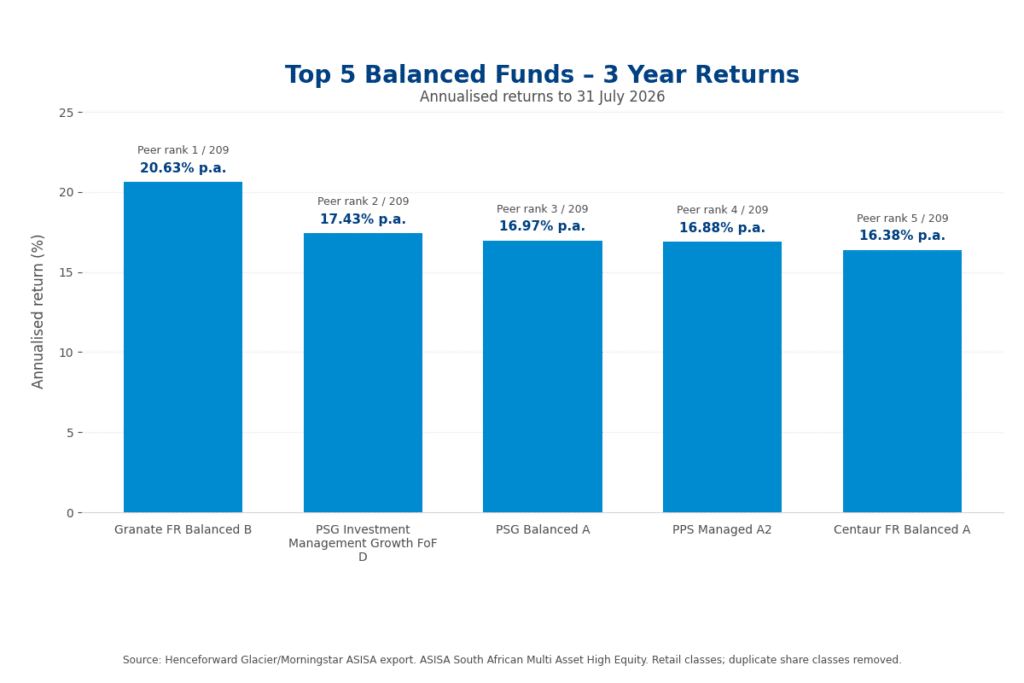
Granate Balanced leads the peer group over this particular three-year period at 20.63% p.a. The gap between it and even the fifth-ranked de-duplicated fund is more than four percentage points a year.
But three years is still a relatively short window for a retirement investment. It can strongly reflect which investment styles, asset classes or market positions happened to work during that particular period. A high three-year ranking is evidence worth investigating; it is not, by itself, evidence that the strategy is the right long-term choice.
Top-performing balanced funds over 5 years to 31 July 2026
| De-duplicated rank | Fund / retail class | 5-year annualised return | Morningstar peer rank |
|---|---|---|---|
| 1 | Granate Balanced | 16.84% p.a. | 1 / 190 |
| 2 | PSG Balanced | 16.82% p.a. | 2 / 190 |
| 3 | PSG Investment Management Growth FoF | 16.27% p.a. | 4 / 190 |
| 4 | ABAX Balanced | 15.74% p.a. | 7 / 190 |
| 5 | PPS Managed | 14.67% p.a. | 8 / 190 |
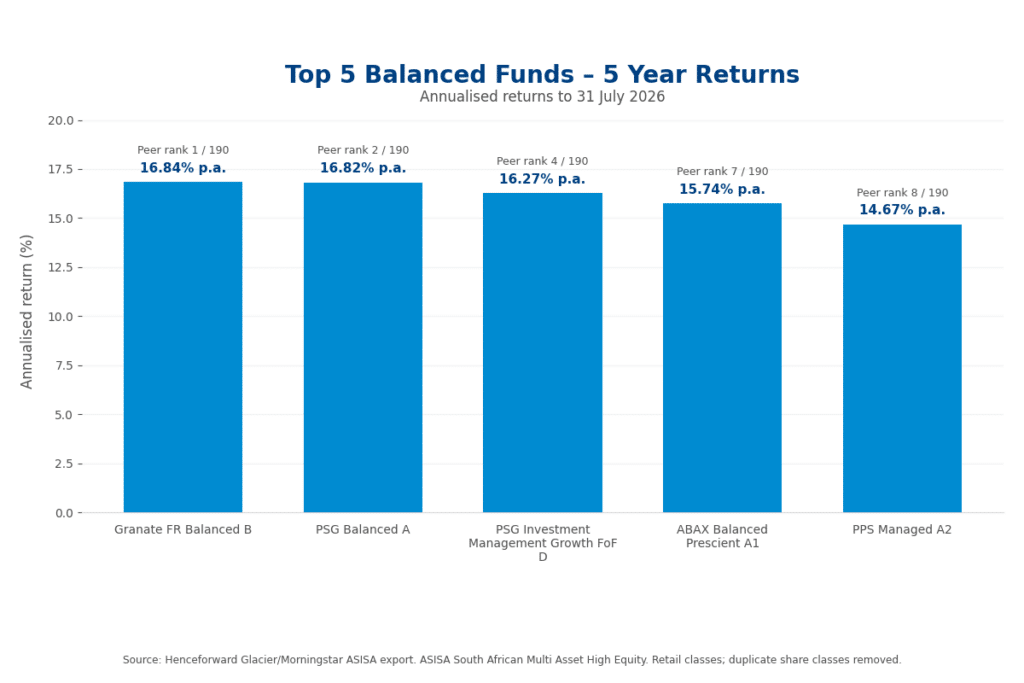
The five-year table changes the order, although some managers remain prominent. Granate and PSG occupy the first three de-duplicated positions, while ABAX enters the table.
ABAX also demonstrates why share-class methodology matters. Cheaper classes of the same underlying strategy occupied intervening positions in the original Morningstar ranking. Rather than counting these as separate “top funds”, we use the A1 retail class here.
A five-year record is more informative than a one- or three-year snapshot, but it can still favour a particular style or starting point. The question is not simply whether a fund has performed strongly, but how that result was produced and whether its investment process remains credible.
Top-performing balanced funds over 10 years to 31 July 2026
| De-duplicated rank | Fund / retail class | 10-year annualised return | Morningstar peer rank |
|---|---|---|---|
| 1 | ABAX Balanced | 11.76% p.a. | 3 / 135 |
| 2 | Aylett Balanced | 11.51% p.a. | 4 / 135 |
| 3 | PSG Balanced | 10.98% p.a. | 5 / 135 |
| 4 | Centaur Balanced | 10.74% p.a. | 6 / 135 |
| 5 | ClucasGray Equilibrium | 10.74% p.a. | 7 / 135 |
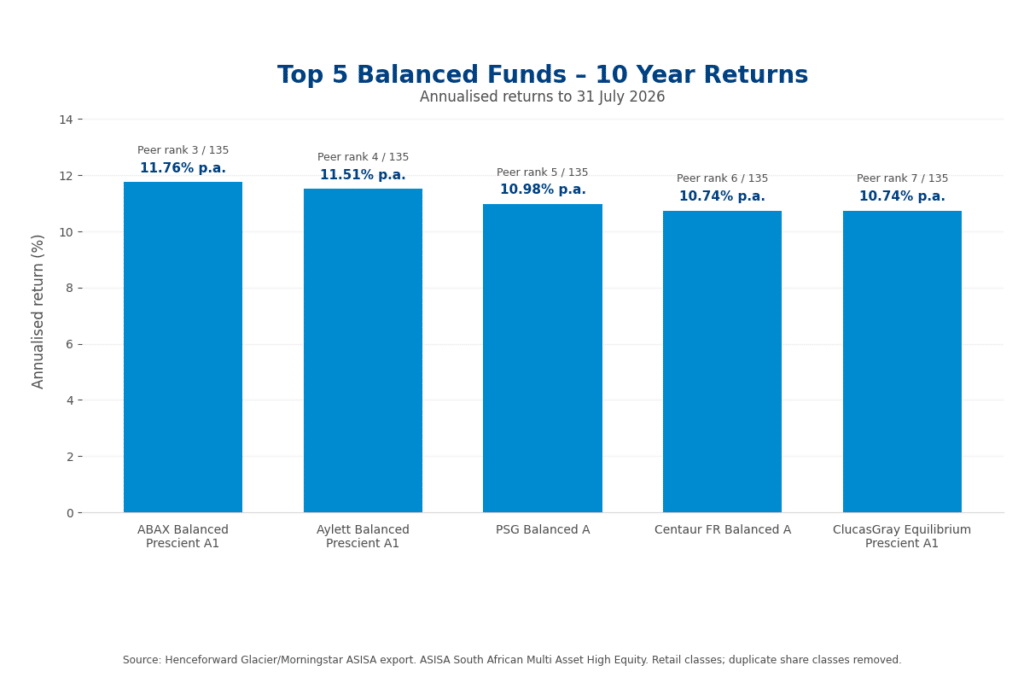
Now the leadership changes again. ABAX Balanced leads the ten-year comparison, followed by Aylett Balanced Prescient. PSG Balanced appears in the top group across all three measurement periods, while Centaur appears in both the three- and ten-year lists.
ABAX again illustrates the fee-class effect. Cheaper classes were ranked first and second in the raw Morningstar data, while the A1 retail class returned 11.76% p.a. and ranked 3rd out of 135 investments. Using the retail class provides a more realistic comparison for the intended reader.
The broader lesson is more useful than any individual ranking: performance leadership changes with the measurement period. An investor who continually switches to whichever fund happens to top the latest table risks buying yesterday’s successful style after much of the outperformance has already occurred.
How passive and core balanced funds compare
One of the more interesting features of the July 2026 data is that low-cost, rules-based and core balanced strategies have remained competitive with a large active-management universe.
| Fund | 3-year return / rank | 5-year return / rank | 10-year return / rank |
|---|---|---|---|
| Satrix Balanced Index | 14.98% — 17 / 209 | 12.49% — 21 / 190 | 10.01% — 11 / 135 |
| Sygnia Skeleton Balanced 70 | 14.30% — 32 / 209 | 12.03% — 37 / 190 | 9.86% — 15 / 135 |
| 10X Your Future | 10.90% — 181 / 209 | 10.45% — 122 / 190 | N/A |
| Nedgroup Investments Core Diversified | 13.99% — 43 / 209 | 12.26% — 26 / 190 | 9.41% — 28 / 135 |
| Prescient Balanced | 14.50% — 26 / 209 | 11.47% — 63 / 190 | 9.86% — 14 / 135 |
10X Your Future does not have a ten-year return in this dataset. Its inception date is 28 February 2019.
Satrix Balanced Index has the strongest overall ranking profile of these five funds: 17th out of 209 investments over three years, 21st out of 190 over five years and 11th out of 135 over ten years.
Prescient Balanced ranks 26th over three years and 14th over ten years. Sygnia Skeleton Balanced 70 is 15th over ten years, while Nedgroup Investments Core Diversified has been particularly competitive over five years at 26th out of 190.
10X Your Future has produced weaker relative results over the available three- and five-year periods than the other four funds in this comparison.
None of that proves that passive management is “better” or “worse” than active management. What it does demonstrate is that low-cost core portfolios can be serious competitors. An active manager therefore needs to justify higher fees and manager-specific risk through an investment process that an investor has reason to believe can add value over an appropriate period.
Some well-known active funds in context
Brand familiarity and historical performance ranking are not the same thing. The same July 2026 peer-group data provides useful context for several established balanced funds:
| Fund | 3-year return / rank | 5-year return / rank | 10-year return / rank |
|---|---|---|---|
| Allan Gray Balanced | 15.18% — 15 / 209 | 14.10% — 11 / 190 | 9.76% — 18 / 135 |
| Coronation Balanced Plus | 12.74% — 100 / 209 | 10.88% — 100 / 190 | 9.14% — 39 / 135 |
| Ninety One Opportunity | 10.49% — 190 / 209 | 9.81% — 152 / 190 | 8.59% — 66 / 135 |
Allan Gray Balanced, for example, ranks strongly across all three periods without topping any of them. Coronation Balanced Plus and Ninety One Opportunity sit materially lower in the peer rankings over the periods shown.
This is another reason not to reduce an investment decision to either brand recognition or the current top-five table. Both can be misleading shortcuts.
What the performance tables really tell us
1. Funds in the same category can produce very different outcomes
Among the selected funds shown in this article, three-year annualised returns range from 20.63% for Granate Balanced to 10.49% for Ninety One Opportunity — a difference of more than ten percentage points a year over that particular measurement period.
The gap narrows over longer periods, but remains meaningful: the equivalent five-year figures range from 16.84% to 9.81%, and the ten-year examples from 11.76% to 8.59%.
Those differences illustrate why the underlying investment portfolio matters. They do not tell us in advance which fund will occupy the top or bottom of the range in future.
2. Leadership changes over time
Granate leads the three- and five-year tables. ABAX leads the ten-year table. Several managers appear in only one period, while PSG Balanced features prominently across all three.
That is exactly what one would expect in competitive investment markets. Different styles work at different times, portfolios change, markets reward different exposures and investment teams evolve.
3. Boutique managers deserve attention — not automatic selection
Several names near the top of these historical tables are smaller or less widely recognised than the industry’s largest retail brands. That is useful evidence against assuming that the best-known provider automatically offers the strongest underlying investment option.
It does not mean smaller managers should automatically be preferred. Manager size, business stability, team depth, succession, liquidity, capacity and key-person risk all belong in proper due diligence.
4. Low cost can be powerful, but cost is not the whole decision
The passive/core table shows that a low-cost approach does not require accepting bottom-half performance. Satrix, Sygnia, Prescient and Nedgroup Core have all produced competitive peer rankings over at least some of the periods measured.
Lower fees are valuable because every rand of unnecessary cost is a rand that cannot compound. But cost should be considered alongside portfolio construction, diversification and expected behaviour in difficult markets. The cheapest investment is not automatically the most appropriate one.
5. These tables tell us very little about downside risk
A return table does not tell you how uncomfortable the journey was.
It does not show maximum drawdown, volatility, downside capture, the time taken to recover after a market fall, or how consistently returns were generated. Two funds can arrive at similar ten-year returns after very different investor experiences.
For retirement money, those characteristics matter. They can influence investor behaviour and may become particularly important as retirement approaches and the consequences of a large loss increase.
6. Share classes can make rankings look more precise than they are
Seeing the same strategy several times near the top of a performance screen does not necessarily mean that several distinct investment strategies have outperformed. It may simply mean that the same portfolio has multiple fee classes.
De-duplicating the data and using an appropriate retail class produces a fairer comparison. It also reinforces a broader point: always check exactly which share class, fee basis and investor type sits behind a published return.
How to evaluate funds inside an RA
If the highest current return is not enough, what should an investor actually consider?
1. Start with the job the money needs to do
A 35-year-old accumulating retirement savings and someone months away from retirement do not necessarily have the same investment problem. Time horizon, required return, existing assets, future contributions and capacity to tolerate losses all influence the portfolio’s appropriate role.
2. Look across several performance periods
Three-, five- and ten-year returns provide different information. Shorter periods may highlight current execution. Longer periods show whether a process has survived more than one market environment. Neither should be read in isolation.
3. Understand the source of the return
Was performance driven by asset allocation, security selection, offshore exposure, a particular investment style or one unusually successful position? A strong result is more useful when you understand what produced it.
4. Examine risk as well as return
Performance should be considered alongside drawdowns, volatility, concentration, recovery periods and downside behaviour. Historical return without historical risk is only half the picture.
5. Add up all the costs
Fund charges are only one layer. Depending on the structure, an RA may also involve platform, administration and advice costs. Compare the total cost of obtaining and maintaining the investment rather than focusing on one fee in isolation.
6. Consider manager and style diversification
Concentrating an entire retirement portfolio with one manager creates dependence on one investment philosophy, team and style. Combining complementary approaches can reduce that dependence, although adding more funds does not automatically create useful diversification.
7. Check Regulation 28 and the wider portfolio
The RA should not be evaluated in isolation from the rest of the household balance sheet. Existing pension assets, discretionary investments, offshore assets and future income needs all affect what role the RA should play.
8. Avoid changing funds simply because rankings move
Performance tables are useful for monitoring and investigation. They are dangerous when turned into an automatic switch signal.
A manager moving from 10th to 40th over a short period does not necessarily mean its investment process has deteriorated. Conversely, a sudden rise to first place does not prove that the manager has become permanently superior. The underlying reasons matter more than the ranking movement itself.
Where an RA fits into the wider retirement plan
An RA can be an unusually useful structure: contributions may qualify for a tax deduction, retirement capital benefits from preservation rules, and Regulation 28 provides a diversified prudential framework.
Those advantages do not mean every available rand should automatically go into an RA. Retirement planning can also require accessible capital, emergency reserves, discretionary investments, tax-free savings, offshore exposure and other assets with different liquidity or estate-planning characteristics.
The 45% offshore prudential limit also means that the foreign exposure available within retirement funds is not unlimited. For some investors, offshore discretionary assets may therefore complement retirement-fund assets as part of a broader strategy. That is a planning decision rather than an argument for or against RAs in general.
At death, retirement-fund benefits are also governed by retirement-fund death-benefit rules rather than simply passing according to a will. Beneficiary nominations are important, but the fund’s statutory duties must also be considered.
The better question is therefore not “Should I have an RA or invest elsewhere?” It is “What combination of structures gives each part of my capital the right job?”
Frequently Asked Questions
What is the best retirement annuity in South Africa?
There is no single retirement annuity that is best for every investor. An RA is a structure containing underlying investments, so a useful comparison considers the portfolio, fees, diversification, Regulation 28, manager risk and your investment horizon. The July 2026 performance tables show historical leaders, not a forecast of future leaders.
Which balanced fund performed best over three years to July 2026?
Granate Balanced Fund ranked first in the Morningstar South African Multi Asset High Equity peer group over three years to 31 July 2026, returning 20.63% p.a. Its ranking is historical and should not be interpreted as a recommendation or an indication that it will lead in future.
Which balanced fund performed best over ten years?
The ABAX Balanced Fund had the highest ten-year return in the comparison at 11.76% p.a. to 31 July 2026.
Are passive balanced funds competitive with active funds?
Some have been. The Satrix Balanced Index Fund ranked 17th out of 209 peers over three years, 21st out of 190 over five years and 11th out of 135 over ten years to 31 July 2026. That evidence supports considering low-cost core strategies seriously, but it does not establish that passive management will outperform active management in future.
How much can I deduct for retirement annuity contributions in 2026?
For the 2026/27 tax year, qualifying retirement-fund contributions are generally deductible up to 27.5% of the greater of remuneration or taxable income, subject to an annual cap of R430,000 and the detailed section 11F rules. The limit applies across qualifying pension, provident and retirement annuity contributions.
The bottom line: use performance as evidence, not as a shopping list
The July 2026 data confirms that fund choice matters. Investors in the same broad South African Multi Asset High Equity category have experienced materially different historical returns, and several smaller managers have competed strongly with much larger brands.
It also shows why a simple “top fund wins” approach is inadequate. Leadership changes between three, five and ten years. Share classes distort rankings. Low-cost core funds can compete strongly. And none of these tables tells us enough about drawdowns, volatility, manager risk or what happens next.
A retirement annuity is ultimately one component of a retirement plan. The useful question is not which fund happens to rank first today, but whether the overall structure, portfolio, costs and risks give your retirement capital a reasonable chance of doing the job required of it over the period that matters.
If you are looking beyond an individual RA and want to understand how retirement funds, discretionary capital, offshore assets and eventual retirement income fit together, our retirement planning guide provides the broader framework.
If you are reviewing an existing retirement annuity, the useful starting point is not simply whether another fund has recently performed better. We can help you assess the portfolio, costs, tax structure and wider retirement plan together.
This article is for general information and education and does not constitute personal financial advice or a recommendation to invest in any fund named above.
Past performance is not indicative of future results. Performance figures are historical to 31 July 2026 and are sourced from the Henceforward Glacier/Morningstar ASISA export for the South African Multi Asset High Equity category. Returns over periods longer than one year are annualised. Rankings and returns can differ by fee or share class, and the figures shown should not be treated as an all-in comparison of platform, administration or advice costs.
Tax and retirement-fund rules can change and individual circumstances differ. Current tax, legal and retirement-fund treatment should be verified before decisions are made.
Henceforward (Pty) Ltd is an authorised representative of Graviton Wealth Management (Pty) Ltd, FSP 8772.

Carl-Peter has been in the financial services industry since 2003 and launched Henceforward with Steven Hall in 2021. He focuses primarily on investment strategy and portfolio construction with a retirement planning lens.