
For most South African trust holders, the question of offshore investing has a frustrating answer: the trust cannot access the same foreign investment allowances that individuals use. The R2 million Single Discretionary Allowance belongs to people, not trust structures.
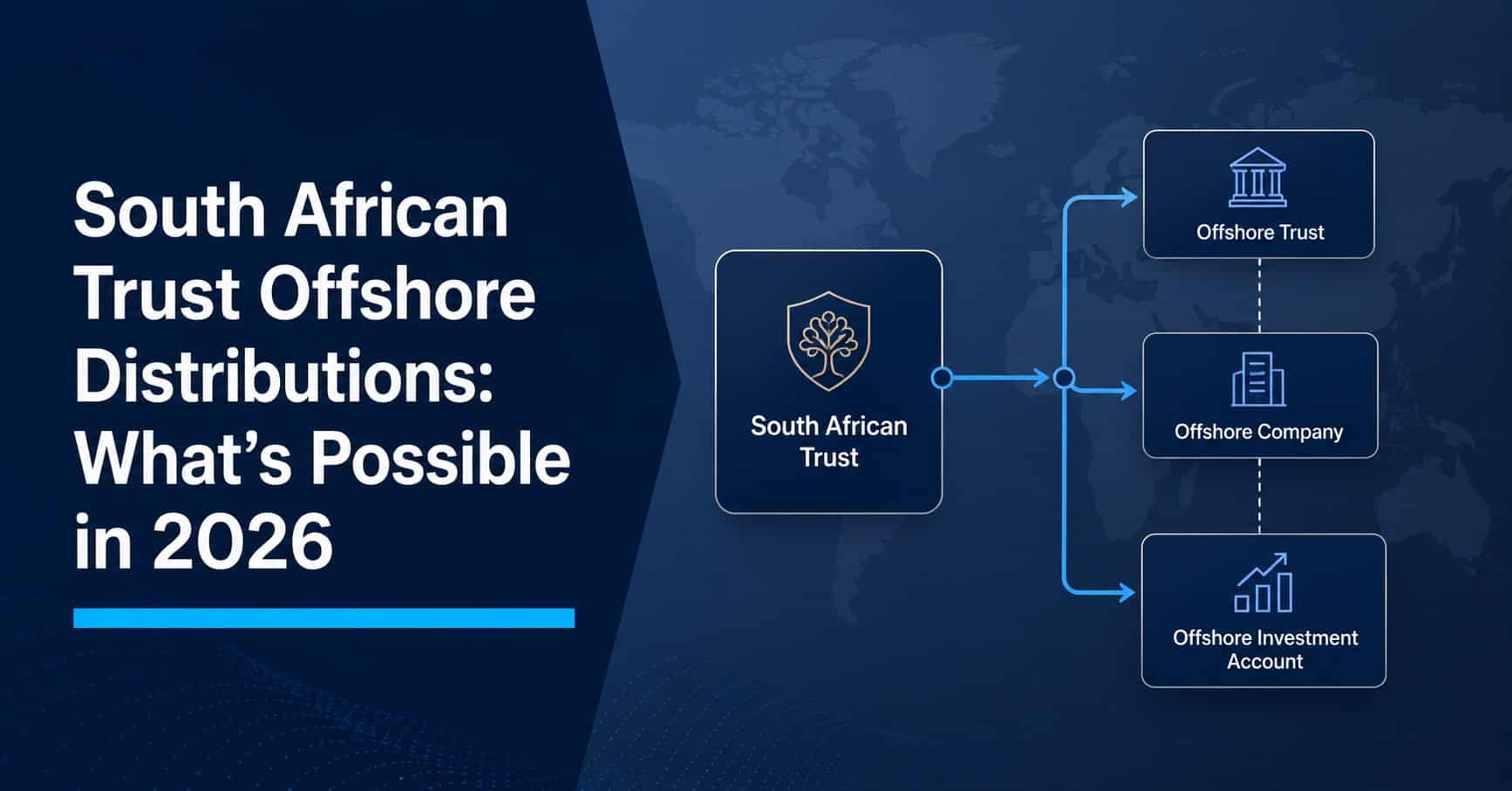
But the position is more nuanced than a flat no. A South African resident trust may make a cash distribution to a foreign trust — provided that foreign trust is named as a beneficiary in the SA deed, SARS issues a Manual Letter of Compliance, and the bank processes the transfer under SARB rules. The route exists. It requires proper preparation, specialist coordination, and careful tax modelling before a rand moves.
The March 2024 changes to the conduit principle added a significant complication: income distributed to non-resident beneficiaries is now taxed in the SA trust at the full 45% income or 36% CGT trust rate. What used to be a clean mechanism for funding an offshore structure now requires the after-tax outcome to be modelled first. In some cases the numbers still support proceeding. In others, an asset-swap structure or individual allowances are the better route.
This guide explains the rules as they currently stand, how the approval process works, and how to think about the decision. For broader context on how SA trusts work and their role in estate planning, our family trust guide covers the full picture — including trustee obligations and the governance requirements that must be in order before any offshore distribution is considered.
Key Definitions
Resident trust
A trust that is tax resident in South Africa — typically because it was established in South Africa or because its effective management and control resides here. Most South African family trusts are resident trusts for these purposes.
Foreign trust (offshore trust)
A trust established in a foreign jurisdiction, governed by that jurisdiction’s laws, and typically administered by professional offshore trustees. Common jurisdictions used by South African families include Jersey, Guernsey, Mauritius, and the Isle of Man.
Single Discretionary Allowance (SDA)
The R2 million annual allowance that allows SA-resident individuals to transfer funds offshore without SARB pre-approval. It applies to natural persons — not to trusts. A resident trust cannot use this allowance.
Manual Letter of Compliance
The formal authorisation issued by SARS to permit a trust-to-trust offshore distribution. Obtaining this letter requires preparing a comprehensive document pack and satisfying SARS that the trust’s tax affairs are fully in order. No distribution can proceed without it.
Authorised Dealer
A bank or financial institution licensed by the SARB to process foreign exchange transactions. The Authorised Dealer verifies the SARS Manual Letter of Compliance and TCS PIN before executing any cross-border trust distribution.
TCS PIN
A Tax Compliance Status PIN — a reference number confirming to a third party that a taxpayer’s tax affairs are in order. Required by the Authorised Dealer as part of the trust-to-trust distribution process.
Asset-swap (local)
An investment arrangement in which a South African rand-denominated fund uses institutional offshore capacity to invest in foreign assets. The trust gains global investment exposure; the proceeds remain in rands; capital does not leave South Africa.
Conduit principle
A tax principle under which trust income distributed to SA-resident beneficiaries in the same year it arises is taxed in their hands (at their individual rates) rather than in the trust (at 45% or 36%). From 1 March 2024, this principle no longer applies where income is distributed to non-resident beneficiaries.
What a Resident Trust Cannot Do Directly
The starting point is what is not available. A South African resident trust does not have access to the foreign investment allowances that individuals use. The R2 million Single Discretionary Allowance and the Annual Investment Threshold — both mechanisms that allow individuals to move capital offshore without prior SARB approval — are personal allowances that belong to natural persons only. A trust cannot use them.
This means a resident trust cannot open a direct foreign brokerage account and invest its capital offshore in the way an individual could using their personal allowances. Any cross-border capital movement from a trust requires a different approval mechanism.
Within South Africa, the practical alternative is an asset-swap structure: the trust invests in a rand-denominated local fund that uses institutional offshore capacity to hold foreign assets on its behalf. The trust gains genuine global investment exposure — to global equities, fixed income, or a multi-asset mandate — without capital physically leaving the country. For trusts where the primary objective is offshore investment exposure rather than offshore domicile, this is often the cleanest, lowest-cost solution. We return to this in the alternatives section.
When Trust-to-Trust Distributions Are Permitted
The route that does exist is a direct distribution from a South African resident trust to a foreign trust that is a named beneficiary in the SA deed. SARB has confirmed that income and capital distributions from inter vivos resident trusts can be transferred abroad — subject to SARS tax-compliance checks and Authorised Dealer processing.
Four conditions must all be satisfied:
- The foreign trust is explicitly named as a beneficiary in the SA trust deed. Being described generally as a class of beneficiary is not sufficient — the foreign trust must be specifically named.
- The SA trustees pass a formal distribution resolution that complies with the terms of the trust deed, specifying the amount, the source of funds, and the rationale.
- SARS issues a Manual Letter of Compliance — a formal approval following submission of a comprehensive document pack.
- The Authorised Dealer (bank) processes the transfer under SARB rules, having verified the TCS PIN and completed its own KYC and AML checks.
This is not a streamlined process. It is a case-by-case approval that hinges on the trust’s tax compliance position being entirely clean. Trusts with outstanding returns, unresolved SARS queries, or incomplete beneficial ownership registers will find the process blocked at the SARS stage. Getting the trust’s compliance in order before initiating the application is a prerequisite, not a step that can be sorted out in parallel.
On the question of what can be distributed: current guidance and practice point firmly to cash distributions. In-specie transfers of shares or property should be treated as not permitted without explicit SARB approval — which in practice is rarely given. If the trust holds assets other than cash and wants to fund an offshore distribution, liquidation to cash in South Africa is the expected first step.
| Requirement | What It Involves | Common Failure Point |
|---|---|---|
| Foreign trust named in SA deed | Explicit beneficiary designation in the trust instrument | Foreign trust established after the SA deed was drafted; deed not updated |
| Trustee resolution | Formal minuted decision specifying amount, source, and rationale | Informal verbal agreement without proper documentation |
| SARS Manual Letter of Compliance | Comprehensive document pack; SARS review; formal approval issued | Outstanding tax returns, incomplete BO register, unresolved SARS queries |
| Authorised Dealer processing | Bank verifies SARS letter and TCS PIN; executes transfer under SARB rules | Incomplete UBO or AML documentation for the receiving offshore trust |
The March 2024 Tax Change: What Changed and Why It Matters
This is the development that fundamentally changed the economics of trust-to-trust distributions, and it is the one most consistently underestimated in planning discussions.
Prior to 1 March 2024, the conduit principle applied to distributions from a resident trust to non-resident beneficiaries. Income distributed to a foreign trust beneficiary was treated as accruing in the foreign trust — the SA trust was not taxed on it. The distribution effectively moved the income offshore in a tax-neutral way.
From 1 March 2024, this changed. The conduit principle no longer applies where income is vested in a non-resident beneficiary — including a foreign trust. Income distributed to an offshore trust is now taxed in the SA resident trust at the full trust rate before the funds leave. That means 45% on income and an effective 36% on capital gains.
The practical implication: where the goal is to fund an offshore structure with trust income, the after-tax cost of that distribution needs to be calculated before committing to the route. For a distribution of R5 million in investment income, the SA trust now bears approximately R2.25 million in tax before the offshore trust receives a cent. Whether the offshore planning benefit justifies that cost depends on the specific circumstances — and the answer is not always yes.
The 2024 change does not make trust-to-trust distributions unworkable. It makes them a decision that requires modelling, not an assumption. Three routes remain available:
- Proceed with the distribution — accepting the SA trust-level tax, if the offshore planning benefit outweighs it.
- Use an asset-swap locally — keeping the funds in the SA trust but gaining offshore investment exposure without the tax cost of distribution.
- Distribute to SA-resident individual beneficiaries, who then use their own personal allowances to invest offshore — avoiding the trust-level tax entirely, though with different control and succession implications.
Which route is appropriate depends on the family’s specific circumstances, the nature of the assets, and the strategic objectives of the offshore structure. There is no universal answer.
The Step-by-Step Approval Process
For trustees proceeding with a distribution to a foreign trust, the process has four stages. None can be skipped.
Stage 1: Trust Deed and Trustee Resolution
Confirm the foreign trust is explicitly named as a beneficiary in the SA deed. If it is not — or was established after the deed was drafted — a deed amendment registered with the Master is required before proceeding. Then pass a formal trustee resolution detailing the amount, source of funds, and rationale. Minutes must be maintained.
Stage 2: SARS Manual Letter of Compliance
Prepare the document pack and submit to SARS for approval. Required documents typically include:
- SA and foreign trust deeds
- Letters of Authority from the Master for SA trustees
- Annual financial statements for the SA trust
- Three-year assets and liabilities schedule
- Bank and investment statements
- Source-of-funds documentation
- Beneficiary schedule
- Proof that all tax returns and taxes are up to date (including the beneficial ownership register)
SARS reviews the pack and, if satisfied, issues the Manual Letter. There is no fixed published timeframe for this. Processing times have varied and should be treated as a potential source of delay. Starting this stage well in advance of any intended transfer date is strongly recommended.
Stage 3: Authorised Dealer Processing
Take the SARS Manual Letter and TCS PIN to the bank. The Authorised Dealer completes its own KYC and AML verification before executing the transfer under SARB rules. The depth of due diligence typically increases with transaction size — for material amounts, expect a more thorough process.
Stage 4: Receiving Trust Onboarding
Ensure the offshore trust’s bank or custodian can satisfy Ultimate Beneficial Ownership (UBO) and AML checks for the incoming funds. This is not always as straightforward as it sounds — offshore institutions apply their own due diligence requirements, and documentation standards vary by jurisdiction. A complete audit trail of all documents and FX flows should be maintained on both sides.
Alternatives Worth Modelling First
Before committing to the trust-to-trust distribution route, the alternatives should be assessed on their own terms. Two are worth modelling carefully in most cases.
Asset-Swap Exposure (Within the SA Trust)
A rand-denominated investment through a local manager using institutional offshore capacity gives the trust genuine global investment exposure — to major equity markets, global fixed income, or a multi-asset mandate — without capital physically leaving South Africa. There is no SARS approval process, no Authorised Dealer involvement, and no tax event triggered by moving funds offshore. The trust simply holds an SA-registered investment that happens to be economically exposed to foreign assets.
Where the objective is offshore investment exposure rather than funding an offshore domiciled structure for succession or estate planning purposes, this route is typically simpler, faster, and cheaper. It also preserves the conduit principle for income distributions to SA-resident beneficiaries.
Individual Beneficiary Allowances
If appropriate to the circumstances, SA-resident beneficiaries can receive distributions from the SA trust and then use their own personal allowances — the R2 million SDA and any AIT-approved transfers — to invest offshore individually. This route avoids the trust-level 45% or 36% tax before a distribution to a non-resident. It does change the succession and control structure, since the funds are now held personally rather than in trust. Whether that trade-off is acceptable depends on the family’s planning objectives.
Practical Scenarios
The family already has a Jersey trust named in the SA deed: A capital distribution to the offshore trust is possible after SARS approval and bank processing. The key step is modelling the post-2024 tax outcome for any income included in the distribution — the tax cost at the SA trust level may be material. Depending on the amounts involved, distributing accumulated capital (rather than current-year income) may result in a more favourable tax position, but the specifics require advice.
The trust wants offshore exposure but the deed doesn’t name a foreign trust: The asset-swap route is the practical path for offshore investment exposure without a deed amendment. If the intention is eventually to fund an offshore trust, a deed amendment to name it as a beneficiary is worth doing properly — which means involving the Master of the High Court and a qualified attorney, not simply drafting an addendum informally.
The trust has an outstanding beneficial ownership register: This must be resolved before any SARS Manual Letter of Compliance will be issued. The register has been required since 1 April 2023. SARS will not approve a cross-border distribution from a non-compliant trust.
We model the after-tax outcomes, prepare the SARS documentation pack, and coordinate with your Authorised Dealer. Because this is a specialist area,
we also work with trusted cross-border tax professionals to ensure SARS compliance
, SARB exchange control documentation, and any double-tax treaty considerations are handled correctly.
Frequently Asked Questions
Can a South African family trust invest directly offshore?
No — not via individual-style allowances. SA resident trusts do not have access to the R2 million Single Discretionary Allowance or AIT-approved channels that individuals use. For offshore investment exposure inside the SA trust, an asset-swap structure (rand-denominated, investing offshore via institutional capacity) is the practical alternative that avoids exporting capital.
Can a South African trust distribute funds to an offshore trust?
Yes, under specific conditions. The foreign trust must be a named beneficiary in the SA trust deed. The trustees must pass a formal distribution resolution. SARS must issue a Manual Letter of Compliance following review of a comprehensive document pack. And the transfer must be processed by an Authorised Dealer under SARB rules. This is a case-by-case approval process, not a standing allowance.
What changed in March 2024 regarding SA trust distributions to offshore beneficiaries?
From 1 March 2024, the conduit principle no longer applies where a South African trust distributes income to a non-resident beneficiary — including a foreign trust. That income is now taxed in the SA resident trust at the full trust rate (45% for income, 36% effective for capital gains) before the funds leave. Previously, the distribution was tax-neutral at the SA trust level. This change materially affects the after-tax economics of trust-to-trust distributions and requires careful modelling before proceeding.
What documents are needed for the SARS Manual Letter of Compliance?
The document pack typically includes: SA and foreign trust deeds, Letters of Authority for SA trustees, annual financial statements, a three-year assets and liabilities schedule, bank and investment statements, source-of-funds documentation, a beneficiary schedule, and proof that all tax returns and taxes (including the beneficial ownership register) are current. SARS reviews the full pack before issuing the letter.
Is the trust-to-trust distribution route worth using given the 2024 tax changes?
It depends on the planning objectives and the amounts involved. Where the goal is offshore investment exposure only, an asset-swap inside the SA trust is typically more efficient. Where the goal is funding an offshore trust for succession or intergenerational planning purposes, the distribution route remains viable but requires upfront modelling of the tax cost at the SA trust level. The answer is specific to the family's circumstances — there is no universal recommendation.
Final Thoughts: Model Before You Move
The trust-to-trust distribution route is a legitimate planning tool. It is also one that requires more preparation and specialist coordination than most families initially expect. The 2024 conduit principle change means that what used to be an efficient mechanism for funding offshore structures now carries a meaningful tax cost at the SA trust level — and that cost needs to be modelled against the alternatives before any capital moves.
The practical question is not whether the route exists. It does. The question is whether it is the right route for a particular family’s circumstances — and that requires an honest comparison of the after-tax outcomes across the available options: distribution to the offshore trust, asset-swap inside the SA trust, or distributions to individual beneficiaries using personal allowances.
Getting the SA trust’s own compliance in order is the prerequisite for any of this. A trust with outstanding returns, an unregistered beneficial ownership register, or an unresolved SARS query will not receive a Manual Letter of Compliance. The administrative foundations need to be sound before the planning conversation can begin.
For the full picture on how family trusts work in South Africa — including trustee obligations, structure, tax, and costs — our family trust guide is the place to start. If you already have a trust in place and are considering the offshore distribution question, we’re happy to model the numbers with you.
If you have an SA family trust and are considering distributing to an offshore structure —
or you’re not sure whether the asset-swap or individual allowance routes would serve you
better — we model the after-tax outcomes and coordinate the specialist tax and SARB
documentation. It’s the kind of question that requires the numbers before an answer.
This article is for informational purposes only and does not constitute financial advice.
Henceforward (Pty) Limited is an authorised representative of Graviton Wealth Management
(FSP 8772). Tax figures referenced are indicative — verify current rates and thresholds at
sars.gov.za before making any decisions. Situs tax thresholds and rules are subject to
change and vary by jurisdiction. Exchange control allowances are subject to SARB policy.
Consult a qualified tax or legal advisor for advice specific to your circumstances.

Carl-Peter has been in the financial services industry since 2003 and launched Henceforward with Steven Hall in 2021. He focuses primarily on investment strategy and portfolio construction. Henceforward is a fee-only, flat-fee firm — no commissions, no product incentives.