
Which global equity unit trusts available in the South African market have produced the highest historical returns over three, five and ten years?
We have updated our rankings using the latest Morningstar data for the (ASISA) Global EQ General category.
As with our South African equity rankings, “best performing” has a deliberately narrow meaning here: the highest historical annualised return over the period measured. It does not mean the fund is the best investment overall, that it will lead in future, or that it is suitable for a particular portfolio.
That qualification matters especially in global equity, where investment styles, geographic exposures, currency effects, concentration and the amount of available history can differ substantially between funds.

- Key Definitions
- How the Rankings Work
- Top 5 Global Equity Funds Over 3 Years
- Top 5 Global Equity Funds Over 5 Years
- Top 5 Global Equity Funds Over 10 Years
- Why the Eligible Universe Shrinks
- Which Funds Appear Repeatedly?
- What to Look at Beyond Returns
- Frequently Asked Questions
- Context Is More Useful Than a Top-Five List
Key Definitions
ASISA Global Equity – General
A category of Global portfolios investing predominantly in equities across sectors and market capitalisations rather than following a specific theme. Under the current ASISA classification standard, Global portfolios invest at least 80% of their assets outside South Africa, while Global Equity portfolios invest at least 80% of market value in equities.
Annualised return
The compounded average annual rate represented by a multi-year total return. It does not mean the investment earned exactly that percentage in each individual year.
Eligible peer universe
The number of funds within the defined category with a valid return covering the full measurement period, excluding benchmark and other non-fund comparator series.
History availability
Whether a fund or retail class has existed for the full measurement period. A fund can have strong recent performance but still be ineligible for a 5- or 10-year ranking because it lacks sufficient history.
Retail fund class
The retail class represented in the source dataset is used for each ranked fund. Reader-facing tables show the underlying fund name without retail-class suffixes or administrator identifiers where these do not help identify the investment strategy. Structural descriptions such as “Feeder Fund” are retained in plain language.
How the Rankings Work
Only funds in the (ASISA) Global EQ General universe with a valid return covering the complete measurement period are included. Benchmark and other non-fund comparator rows are excluded.
For these rankings, we use the retail fund class represented in the source dataset.
To keep the tables useful to readers, we display the underlying fund name rather than Morningstar’s source-data class code or administrator abbreviation. Retail-class suffixes and identifiers such as FR or SCI are omitted where they do not help identify the underlying investment strategy. Where an abbreviation describes the actual structure — for example, a feeder fund — we use the full descriptive name instead.
The exact source series and retail class remain part of our internal data reconciliation.
Returns over periods longer than one year are annualised.
Performance data to 31 August 2026.
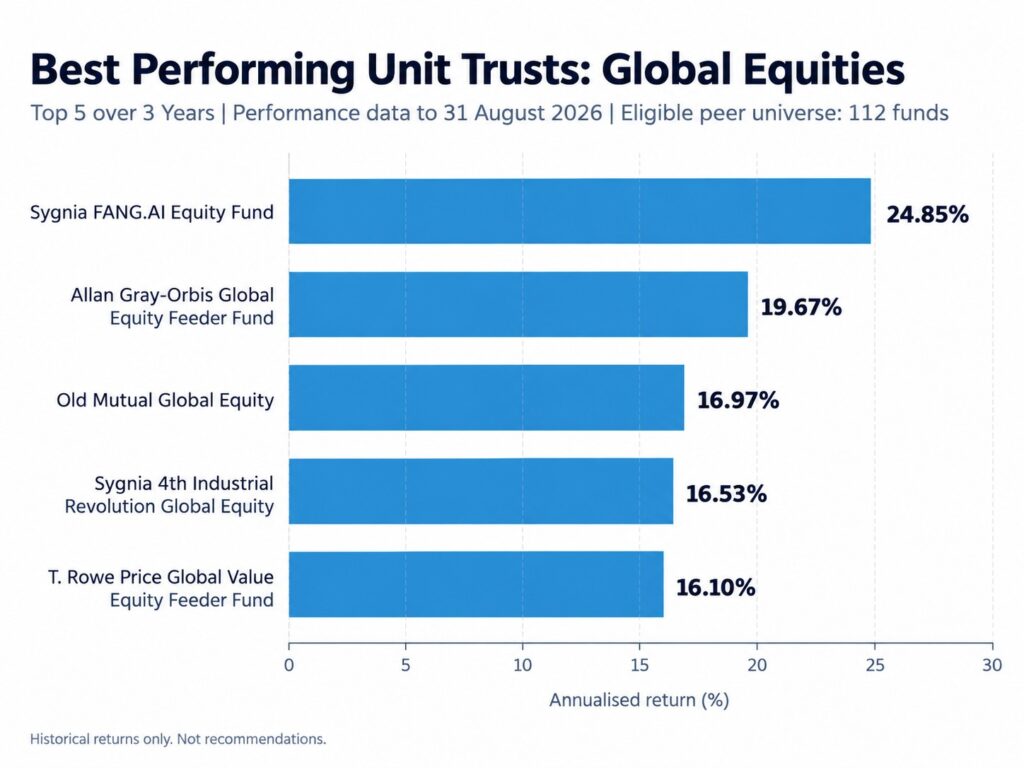
Top 5 Global Equity Funds Over 3 Years
112 funds had a valid three-year return.
| Rank | Fund | 3-year annualised return |
|---|---|---|
| 1 | Sygnia FANG.AI Equity Fund | 24.85% |
| 2 | Allan Gray-Orbis Global Equity Feeder Fund | 19.67% |
| 3 | Old Mutual Global Equity | 16.97% |
| 4 | Sygnia 4th Industrial Revolution Global Equity | 16.53% |
| 5 | T. Rowe Price Global Value Equity Feeder Fund | 16.10% |
Sygnia FANG.AI Equity Fund leads the three-year table by a meaningful margin.
The important thing is not to confuse a high historical return with a complete fund assessment. A concentrated or differentiated strategy can behave very differently from a broad global-equity portfolio even if both sit within a comparable fund universe.
Two names in this table — Allan Gray-Orbis Global Equity Feeder Fund and Old Mutual Global Equity — also make both longer-period top fives.
Top 5 Global Equity Funds Over 5 Years
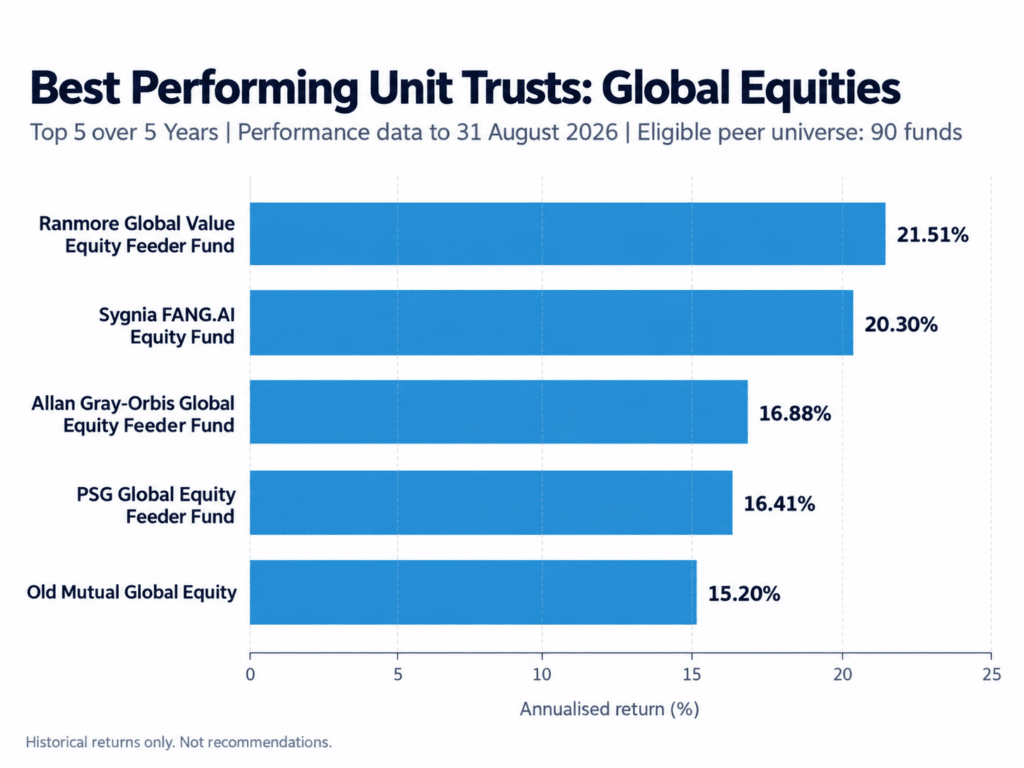
90 funds had a valid five-year return.
| Rank | Fund | 5-year annualised return |
|---|---|---|
| 1 | Ranmore Global Value Equity Feeder Fund | 21.51% |
| 2 | Sygnia FANG.AI Equity Fund | 20.30% |
| 3 | Allan Gray-Orbis Global Equity Feeder Fund | 16.88% |
| 4 | PSG Global Equity Feeder Fund | 16.41% |
| 5 | Old Mutual Global Equity | 15.20% |
Changing the period changes the leader.
Ranmore Global Value Equity Feeder Fund sits first over five years despite not appearing in the three-year top five. Sygnia FANG.AI Equity Fund remains near the top. Allan Gray-Orbis and Old Mutual remain present but in different positions.
That is precisely why a single trailing period should not be allowed to carry too much weight.
Top 5 Global Equity Funds Over 10 Years
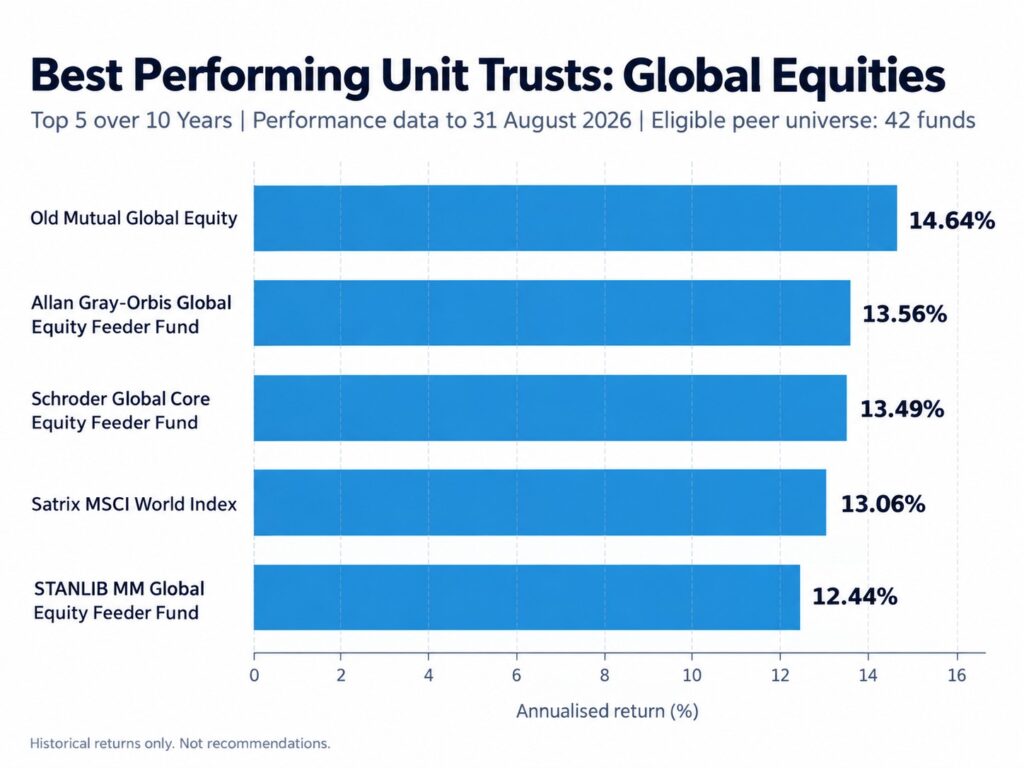
42 funds had a valid ten-year return.
| Rank | Fund | 10-year annualised return |
|---|---|---|
| 1 | Old Mutual Global Equity | 14.64% |
| 2 | Allan Gray-Orbis Global Equity Feeder Fund | 13.56% |
| 3 | Schroder Global Core Equity Feeder Fund | 13.49% |
| 4 | Satrix MSCI World Index | 13.06% |
| 5 | STANLIB MM Global Equity Feeder Fund | 12.44% |
By ten years, the universe has shrunk to only 42 eligible funds.
Old Mutual Global Equity leads. Allan Gray-Orbis remains second. The Satrix MSCI World Index appears fourth, so the long-term top five includes both active strategies and a broad market index fund.
That is an interesting result; it is not enough evidence to declare either active or index investing superior.
Why the Eligible Universe Shrinks
The change is substantial:
- 112 funds have a valid three-year return;
- 90 have five years; and
- only 42 have a complete ten-year return.
A fund cannot be ranked over a period for which it does not have a complete performance history.
This creates a simple but often overlooked distinction between historical performance and history availability.
Sygnia FANG.AI Equity Fund, for example, is first over three years and second over five. Its absence from the ten-year table does not mean its ten-year performance was poor. It did not exist for the whole ten-year period.
Similarly, a newer fund can be one of the strongest recent performers while being entirely absent from a decade-long comparison.
The ten-year table is therefore a comparison of a much smaller and older subset of the current category.
There may also be survivorship effects caused by fund closures and mergers, but the source workbook does not allow us to quantify them reliably. The shrinking universe should therefore not automatically be described as survivorship bias.
Which Funds Appear Repeatedly?
Two funds appear in all three tables:
Allan Gray-Orbis Global Equity Feeder Fund
3 years: 2nd
5 years: 3rd
10 years: 2nd
Old Mutual Global Equity
3 years: 3rd
5 years: 5th
10 years: 1st
That tells us both funds have ranked strongly across several trailing periods ending on 31 August 2026.
It does not prove what caused that performance, whether their current portfolios resemble those that generated earlier returns, or whether they will remain among the leaders.
Answering those questions requires qualitative research rather than another performance column.
What to Look at Beyond Returns
A global-equity fund comparison becomes more useful when the return table is followed by a few less glamorous questions.
Mandate and geographic exposure: Is the fund genuinely broad global equity, or does it carry material regional or sector tilts?
Concentration: How dependent has performance been on a relatively small number of companies or themes?
Investment style: Value, growth, quality and other styles can lead or lag for long periods.
Volatility and drawdowns: A strong annualised result can disguise a difficult path.
Currency: The currency in which a return series is reported and the currencies of the underlying investments are not the same thing. A South African investor should understand both before comparing vehicles.
Fees and implementation: The investor’s actual cost can extend beyond the fund-level return series.
Manager and process: Historical performance can prompt further research, but it does not replace it.
Portfolio role and diversification: Even an excellent fund can be a poor addition if it simply doubles exposure already present elsewhere.
For broader context, see our offshore investing guide and our guide to offshore investment wrappers.
Frequently Asked Questions
What is the best-performing global equity unit trust?
It depends on the period. To 31 August 2026, Sygnia FANG.AI Equity Fund leads over three years, Ranmore Global Value Equity Feeder Fund over five years, and Old Mutual Global Equity over ten years within the ASISA Global Equity General universe. Those are historical-return rankings only. They do not establish which fund is “best” for the future or for a particular investor.
Why are only 42 funds included in the ten-year ranking?
A fund must have a complete ten-year return history to qualify. Many funds or retail classes available today were launched after the beginning of the ten-year measurement period. The eligible universe therefore falls from 112 funds over three years to 42 over ten years.
Why isn't the three-year winner in the ten-year table?
Sygnia FANG.AI Equity Fund does not have sufficient history to produce a valid full-period ten-year return as at 31 August 2026. Absence from a longer-period table can therefore be a history issue rather than a performance issue.
Does a global unit trust protect me from rand weakness?
Global assets can introduce foreign-currency exposure, but the effect depends on the fund structure, reporting currency and underlying holdings. Offshore investing should not be reduced to a one-way currency bet; diversification, investment opportunity, risk and the investor's wider balance sheet all matter.
Are index funds competitive with active global equity funds?
The current ten-year top five includes Satrix MSCI World Index alongside actively managed funds. That tells us an index strategy ranked strongly in this particular historical comparison. It does not by itself settle the broader active-versus-passive question.
Context Is More Useful Than a Top-Five List
A performance table is factual, simple and seductive. The difficult part is deciding what weight to give it.
The August 2026 data shows that the leaders change depending on the period, and that the number of funds you are actually comparing collapses as the horizon lengthens. It also shows that recurring historical performers can coexist with newer funds that have strong shorter-term records but no decade-long history.
That is more useful than trying to identify a permanent winner.
Use the rankings to identify questions worth investigating. Then look at the mandate, portfolio, risk, fees, people and process before drawing an investment conclusion.
For the corresponding domestic comparison, see our South African equity unit-trust rankings.
Historical rankings can help identify funds worth understanding, but they cannot determine the right offshore allocation or strategy for you. Henceforward helps investors assess global exposure in the context of their wider portfolio, objectives, costs and financial plan.
Performance data to 31 August 2026. Source: Morningstar data. Rankings exclude benchmark and other non-fund comparator series and include only funds with a valid return for the full measurement period. Figures are rounded to two decimal places. Returns over periods longer than one year are annualised.
Past performance is not indicative of future results. Historical rankings do not constitute a recommendation to buy, retain or sell any fund. This article contains general information and does not take account of any person’s objectives, financial position or needs.
Henceforward (Pty) Ltd is an authorised representative of Graviton Wealth Management (Pty) Ltd, FSP 8772.

Carl-Peter has been in the financial services industry since 2003 and launched Henceforward with Steven Hall in 2021. He focuses primarily on investment strategy and portfolio construction. Henceforward is a fee-only, flat-fee firm — no commissions, no product incentives.